

AG Noorani
Challenges to Civil Rights Guarantees in India
Rs. 1,192
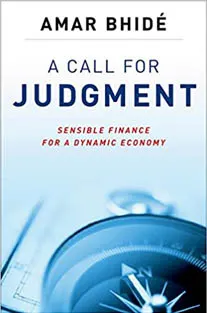
Amar Bhide
Oxford University Press
Our prosperity requires the enterprise of innumerable individuals and businesses who exercise their imagination and judgment-and bear responsibility for outcomes. And widespread enterprise is fostered through dialogue and relationships, not merely prices in anonymous markets. Yet modern finance blatantly neglects these necessary elements for enterprise. In the last several decades finance has become increasingly centralized, distanced, and mechanistic. Instead of many lending officers making judgments about borrowers they know, credit decisions are the output of the models of a few Wall Street wizards and credit agencies. This robotic centralized finance stifles the dynamism of the real economy and leads to recurring collapses.
A Call for Judgment clearly explains how bad theories and mis-regulation have caused a dangerous divergence between the real economy and finance. In simple language Bhidé takes apart the so-called advances in modern finance, showing how backward-looking, top-down models were used to mass-produce toxic products. Thanks to excessively tight securities laws and loose banking laws, anonymous transactions have displaced relationship-based finance. And Bhidé offers, tough simple rules for restoring relationships and case-by-case judgment: limit banks–and all deposit taking institutions–to basic lending and nothing else.
A Call for Judgment is both a primer on the role of finance in a dynamic modern economy, and a cautionary tale about the pitfalls of banks functioning as highly centralized, mechanistic entities. It is essential reading for anyone interested in bringing the economy back to a point at which decisions can be made that foster organic economic growth without the potentially disastrous risks currently accepted by modern finance.
The book
Our prosperity requires the enterprise of innumerable individuals and businesses who exercise their imagination and judgment-and bear responsibility for outcomes. And widespread enterprise is fostered through dialogue and relationships, not merely prices in anonymous markets. Yet modern finance blatantly neglects these necessary elements for enterprise. In the last several decades finance has become increasingly centralized, distanced, and mechanistic. Instead of many lending officers making judgments about borrowers they know, credit decisions are the output of the models of a few Wall Street wizards and credit agencies. This robotic centralized finance stifles the dynamism of the real economy and leads to recurring collapses.
A Call for Judgment clearly explains how bad theories and mis-regulation have caused a dangerous divergence between the real economy and finance. In simple language Bhidé takes apart the so-called advances in modern finance, showing how backward-looking, top-down models were used to mass-produce toxic products. Thanks to excessively tight securities laws and loose banking laws, anonymous transactions have displaced relationship-based finance. And Bhidé offers, tough simple rules for restoring relationships and case-by-case judgment: limit banks–and all deposit taking institutions–to basic lending and nothing else.
A Call for Judgment is both a primer on the role of finance in a dynamic modern economy, and a cautionary tale about the pitfalls of banks functioning as highly centralized, mechanistic entities. It is essential reading for anyone interested in bringing the economy back to a point at which decisions can be made that foster organic economic growth without the potentially disastrous risks currently accepted by modern finance.
Details
Same publisher
AG Noorani
Rs. 1,192
SAHRDC
Rs. 560
Ali S Awadh Asseri
Rs. 720
Jeffrey F Addicott, Md. Jahid Hossain Bhuiyan, and Tareq MR Chowdhury
Rs. 1,160
Ashwani Peetush, Jay Drydyk
Rs. 1,432
Matthew H Kramer, NE Simmonds, Hillel Steiner
Rs. 872
Jeffrey F Addicott, MD Jahid Hossain Bhuiyan
Rs. 1,160
Philip Alston & Mary Robinson
Rs. 1,600
Daniel Fischlin, Martha Nandorfy
Rs. 632
SAHRDC
Rs. 760
David Feldman
Rs. 15,000
Richard Stone
Rs. 8,400
Same shelf
Hugh Selby
Rs. 640
Elspeth Reid and David L Carey Miller
Rs. 21,500
PM Roth
Rs. 5,600
W Friedmann
Rs. 1,780
Michael S Teitelbaum & Myron Weiner
Rs. 1,150
John Forge
Rs. 16,800
Dipankar Gupta
Rs. 1,350
Carsten Stahn
Rs. 16,500
David Miller
Rs. 9,750
Joseph P Forgas, Kipling D Williams, and William von Hippel
Rs. 18,000
Peter Seddon
Rs. 6,850
Rs. 495
Rs. 13,900× 9